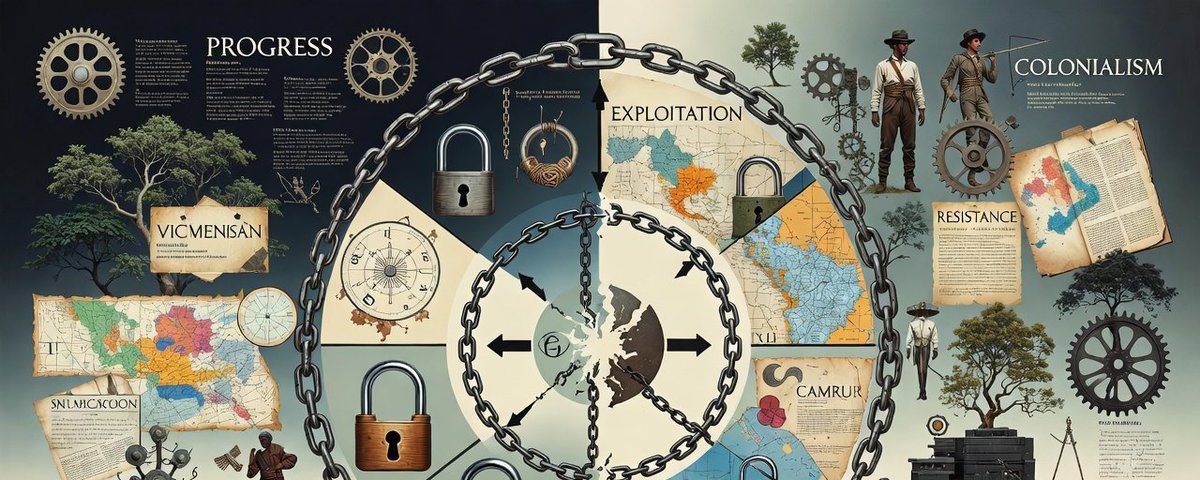

Before I get started, I'd like to point out that this is a one-off piece, a long string of loosely connected thoughts, coalesced together in search of answers to questions like:
- Why are some communities more successful than the others?
- Are some races inherently superior to others?
- Would the world have been a better place if Europeans simply minded their business?
- Are African states in a bad place because of stolen resources or because they are bad at managing what they have?
I assume no authority in history or political science, but I've consumed a lot of thoughts, ideas, and potentially misinformation in the past couple weeks, always mostly anchored at two extreme ends, with little room for nuance. This piece attempts to explore a middle ground, you’re free to disagree.
The power of "Beliefs"
The most powerful tool humans possess is the ability to "imagine". Virtually everything we’ve brought into existence — from monumental inventions to the coordination of billions, owes its birth to this singular superpower.
Everything from laws, to economics, religions, corporations, cultures etc are mostly powerful myths, where their power lies not in physical reality, but in collective acceptance. The US dollar has value because people believe it will be accepted anywhere. Corporations exist because laws recognize them. A billionaire can secure massive loans not because the cash exists somewhere, but because institutions believe the narrative of their worth.
At the centre of our very existence are our beliefs and ideologies, they are the lenses through which we process and interact with reality, and thus sits at the core of this article.
Curiosity as an institution
Colonialism did not begin with Europe. Human history is full of empires — Achaemenid, Roman, Ottoman, Mughal, Mongol, Qing, all expanding through conquest, extraction, and domination. What changed with Europe was scale.
At the centre of Imperialism (or colonialism as we know it today), was the solemn belief that their superior prosperity and advanced civilization entitled them to "civilize" the so-called barbarians — often through raids on neighboring villages, plunder, enslavement, and forced indoctrination into the ways of the empire.
But up until the Europeans, this was usually done on a smaller scale. When bigger empires annexed surrounding villages, it was either because they had something they needed, or to protect the Empire's borders.
So what changed? how did we go from Empires swallowing up surrounding villages, to sailing thousands of kilometers to annex places totally unheard of? And how were the Europeans able to do this, despite having way less resources compared to some of the largest empires that had come before them?
For context, as at the 16th and 17th Century, Asia accounted for 75 to 80% of global GDP, with China and India (under the Mughal Empire) alone making up for around 50 to 55%. Europe, by comparison, was fragmented, poorer, and late to the global supply chain. So how did relatively weaker European states initiate global colonialism?
Institutionalized Curiosity.
The golden age for Europe came with the Industrial Revolution. Not because Europeans were inherently more curious, but because curiosity became institutionalized. Fragmented states competed relentlessly. Monarchs funded risky expeditions, scientific inquiry was rewarded and military and commercial innovation became survival tools.
At the dawn of this age, you could argue the Chinese, the Ottoman, and Mughal empires were not vastly behind the Europeans technologically and thus couldn't have struggled to catch up to the west. Proof of this lies in the fact that most of the technology that allowed Europeans cross oceans were synthesized from other cultures, e.g. the magnetic compass (adopted from China), the Astrolabe and Quadrant used for calculating latitude (adopted from Islamic scholars) and even Lateen sails.
Europe’s advantage was barely invention alone, but relentless adoption, iteration and application at scale.
Colonialism: A blessing or a curse?
The most prevalent argument of the past weeks on TwitterNG has been around the topic of if Nigeria and most of Africa fared better under colonial rule than they do today.
And as with all arguments on X, you either had to be on either of the opposing ends to make sense, but could there be a bit more to the story?
With European colonialism, we had the same script replicated everywhere:
Arrive as traders → study local systems → assert dominance → build extraction infrastructure → justify with “civilization.”
And thus to proceed, we must first establish that colonialism was never done in good faith, albeit justified in many forms, the primary motive was always exploitation.
The Illusion of Good
Whenever someone tries to argue that colonialism had upsides, the same three points come up like clockwork: Infrastructural and institutional development, education and global access, and political unification. In fact we've seen arguments made as to how colonizers left behind rails, roads, modern infrastructures, governance systems, etc for the developing world only for them to let it rot, as argued here by @thelaurenchen.
And whilst the argument might seem logical enough on a first glance, it ignores the systemic problems created by the colonizers that led to the vicious cycle a lot of the developing world find themselves in, today.
Unlike most of Europe where you had railroads criss-crossing and interconnecting cities, railways and roads established in Africa where done primarily for extraction establishing straight lines from mines and plantations directly to ports.
Colonial governments, especially through "indirect rule," imposed chiefs and leaders where none had existed before — creating systems that rewarded loyalty to the empire far more than competence.
Education was not as wide-spread as you might think, but served as a tool to assist locals catch up in order to help the colonial masters manage their colonies.
The forceful unification of tribes and ethnicities, with totally different shared beliefs, myths, religions and cultures led to unstable systems enduring difficult tensions like the muslim-christian clashes in Nigeria today.
So whilst there might have been some accidental benefits to colonialism, such as exposure to modern technology, scientific empowerment, and most importantly abolishment of dangerous local practices such as human sacrifices and twin killings, it did undeniably more harm than good.
Caught in a Vicious Cycle
After two centuries, Imperial Britain made the move to outlaw slavery, ending the Atlantic slave trade.
By 1865, the thirteenth Amendment of the US constitution outlawed slavery, and the fourteenth amendment, emphasized equal protection of the law, regardless of race.
But at this point, after two centuries of slavery, most black families lived in poverty and had less chances of getting a good job or a proper education as compared to their white counterparts. Over generations, inequality reproduced itself, not because of inherent inferiority, but because starting positions mattered. Stereotypes then emerged to justify outcomes that history had engineered.
So as decades passed by, blacks were characterized as less intelligent, lazier and with more tendency to violence. A stigma that led to a vicious cycle that would take nearly a century to break out off.
The same logic applies to post-colonial societies. Nigeria for example, was structured as a supplier of raw materials and a consumer of finished goods. Political borders were drawn with no regard for social realities, a pattern that still shapes its economy today.
This created a feedback loop — poverty reinforcing stigma, stigma reinforcing exclusion, exclusion reinforcing poverty. Agency still exists no doubt, but it operates within constraints built long before independence.
Breaking Out
“If you wish to get out of prison, the first thing you must do is realize that you are in prison. If you think you are free, you can’t escape.” — George Gurdjieff
Breaking a vicious cycle begins with recognizing it exists. But more importantly, acknowledging that reorientation takes time, discipline and deliberate efforts, as you're rewiring both broken institutions and deeply ingrained collective psychology. We're talking decades to centuries of intentional redesign.
And here's an opinion you might not agree with; Democracy as a political system, while morally appealing struggles to fix these issues.
Don't get me wrong, democracy is a beautiful system, the problem lies in the numerous cracks from which the system is usually exploited in post-colonial states like Nigeria. Elections exist but institutions are hollow, voters are uninformed and easily manipulated, there's neither coordination nor accountability. The added challenge of short electoral cycles further limits the ability to pursue long-term, structural reforms.
That does not make Authoritarianism the golden solution though, because while it has enabled rapid transformation in some contexts — China being the most cited example, it has also produced catastrophic failures most places, could the contrast be cultural? (maybe we'll explore that sometime in the future).
The answer I think, lies not in ideology, but in design. Singapore for example has seen great success from combining elements from both systems (long-term planning, meritocratic bureaucracy, limited political competition and gradual accountability). They’ve been able to build a system that works for the people, maybe we need to do the same too.
Another domain I've been exploring, unique to the Nigerian context is federalism. If executed properly, devolving power would encourage competition between regions, aligning responsibility with consequence.
Finally, the extractive economic model we currently maintain, must be dismantled. Local industrialization, protection of infant industries, research investment, and a shift toward self-sufficiency are non-negotiable.
Conclusion
In conclusion, this article was written not to serve as an indictment to any race, nation or system, nor is it an attempt to excuse present-day failures by endlessly pointing backwards, but to find a possible explanation for our problems in order to find a path forward. History explains, but it does not absolve.
Colonialism did not just plunder resources, it reshaped a lot of societies in ways that continue to echo long after political independence. A starting disadvantage that compounds if not deliberately addressed.
The tragedy of many post-colonial states is not that they were once colonized, but that they still attempt to run on systems never built for their success. Breaking out of a vicious cycle begins not with blame or denial, but with clarity. And clarity, uncomfortable as it might be, is often the first real step towards change.